Alex Leong / Instructional Designer

The aim of this concept project is to help learners make appropriate decisions to assist patients in coping with gaming addiction and adopting an active lifestyle.
Audience
Responsibilities
Tools used
Junior physicians
Action mapping, instructional design, visual storyboard, script writing, xAPI
Articulate Storyline, Figma, PowerPoint, Mindmeister, Veracity LRS, Visual Script Code
The Problem
FirstLife Hospital is a fictional healthcare provider that offers personalized care, treatment plans, and community support for individuals with mental health disorders, including gaming addiction.
The client recognizes that insufficient communication and empathy training for physicians, particularly junior physicians, can hinder their capacity to effectively handle patients with gaming addiction. Inadequately managed addiction cases can lead to decreased patient satisfaction and a damaged reputation for delivering comprehensive and patient-centered care. Patients may persistently grapple with ongoing addiction issues, resulting in frustration and diminished trust in the healthcare system.
The Solution
I recommend utilizing scenario-based eLearning to assist junior physicians in enhancing their decision-making skills within a secure environment. This approach not only enables them to understand the repercussions of common errors but also helps prevent their repetition in real-life situations.
Moreover, I suggest establishing a platform where physicians can exchange success stories and learn from one another's valuable experiences.

1. Action Mapping
I used action mapping to assist the client and subject matter experts in focusing on what junior physicians need to do to achieve the identified performance goal, which in this case is to increase the number of patients recovering from gaming addiction.
First, I guided them through the process of defining the business and performance goals. Then, we identified the target audience, pinpointed the observable actions and common mistakes, and barriers that were preventing the learners from achieving the performance goal.
Once we had a list of actions and sub-actions, I proceeded to help the clients and subject matter experts identify the top three actions and sub-actions that contribute the most to the performance goal or have the most serious consequences if not performed (highlighted in colors).
Each of these actions and common mistakes will be translated into correct answer choices and distractors in the practice activities.

2. Text-based Storyboard and Scripting
I used a text-based storyboard as a blueprint for my project.
The actions on the map provided a foundation for creating scenarios. Based on these actions, I brainstormed ideas for each scenario and decision point in the story. I documented the scenarios and decision points in the storyboard, which includes scripts for user scenarios, navigation options, learner questions, consequences linked to the user's answer choice, and help text for optional help screens at crucial decision points throughout the course.
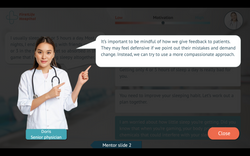
Following Mayer's personalization principle, I created all scenarios and decision points in a conversational style. Additionally, I included a virtual mentor to guide learners through the course and provide feedback and support. The feedback is designed to have a conversational style
 |  |  |
|---|---|---|
 |  |
3. Visual Mockups
I used Figma to create and refine the mood board and visual mockups because it allows me to apply changes quickly and efficiently to wireframes across all instances without the need to modify them individually.
The mood board and visual mockups are important to ensure design consistency throughout the project. I created a custom theme and template for the project and iterated on the look and feel of the slides. I used royalty-free images and made some edits to keep the project expenses low, Once the mockup was nearing completion, I moved everything into Storyline to refine the states of the buttons and start building triggers.
 |  |  |
|---|---|---|
 |  |
4. Full Development
After the prototype has been approved by the client and subject matter experts, the next step is to use Articulate Storyline to build a fully functional course. This involves creating layers, triggers, variables, and a progress bar to enhance the interactivity of the course.


xAPI, JavaScript, and LRS
I developed a tailored xAPI solution aimed at monitoring and analysing learning experiences, and gaining insights into the performance of my learners. This encompasses the frequency of learners selecting best, average, and bad responses, the specific slide at which each response is recorded, the time taken to address each question, and the frequency of resource utilisation.
The accumulation of these metrics allows me to gauge the efficacy of the instructional content, subsequently making necessary improvements for subsequent iterations.

